 Skip site navigation


- The cartridge heater tailored to your industrial needs
- Features of our Stainless Steel Cartridge Heaters
- Color chart
- Industrial Applications for Cartridge heaters
- Available Heater Models
- Installation & Maintenance Tips
- Accessories
- Leads & Sleeves
The cartridge heater tailored to your industrial needs
An industrial cartridge heater is a cylindrical electric heating element designed to provide precise, localized heat. It is commonly used to heat metal blocks, molds, and other industrial components. The heater consists of a resistance wire wound around an insulating ceramic tube and enclosed in a stainless steel sheath for efficient heat transfer.
Volton manufactures and supplies custom cartridge heaters for various industrial heating applications. Our range includes high temperature cartridge heaters, immersion cartridge heaters, and cartridge heaters with integrated thermocouples. These models can be paired with a cartridge heater controller to monitor and regulate temperature according to application requirements.
Features of our Stainless Steel Cartridge Heaters
Volton's custom cartridge heaters are designed to meet demanding industrial heating requirements. They offer several configuration options to accommodate operating temperatures, equipment dimensions, and application conditions:
- Custom manufacturing: 321 stainless steel sheath designed to support efficient heat transfer.
- Precision tolerances: Standard diameter tolerance of -0.002 to -0.006 inches, with optional centerless grinding for applications requiring a precise fit.
- Temperature range: Operating temperatures from 554°F (290°C) up to 1,400°F (760°C). Higher temperatures may be possible depending on watt density and operating conditions.
- Integrated thermocouple: Selected models can include an integrated thermocouple for accurate temperature measurement.
- Voltage and phase options: Available from 120 V to 600 V, with single-phase and three-phase configurations.
- Custom options: Uniform heat profiles, extended cold sections, right-angle lead exits, and grounding wires.
- Temperature control: Compatible with suitable cartridge heater controllers for precise heating power regulation.
- Safety certifications: CSA and UL certifications indicated for applicable industrial models.
Color chart
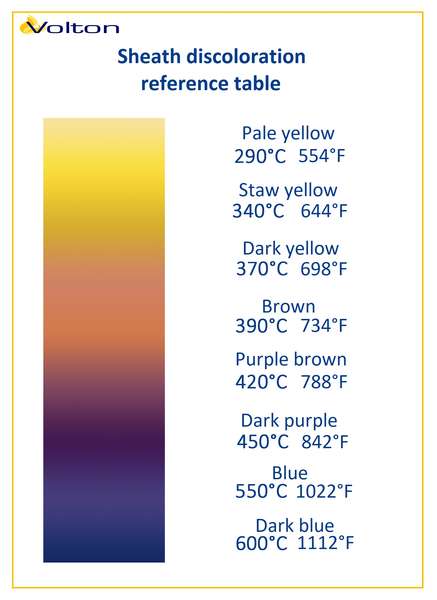
The sheath of a cartridge heater may change color when exposed to different temperatures. This reference chart illustrates sheath discoloration, ranging from pale yellow at 290°C (554°F) to dark blue at 600°C (1,112°F).
The chart associates the following colors with temperatures:
- Pale yellow: 290°C (554°F)
- Straw yellow: 340°C (644°F)
- Dark yellow: 370°C (698°F)
- Brown: 390°C (734°F)
- Purple brown: 420°C (788°F)
- Dark purple: 450°C (842°F)
- Blue: 550°C (1,022°F)
- Dark blue: 600°C (1,112°F)
Industrial Applications for Cartridge heaters
Industrial cartridge heaters provide precise, localized heat for a wide range of manufacturing equipment. Common applications include:
- Packaging and sealing: Precise, uniform heating of components used in industrial packaging and sealing equipment.
- Plastic extrusion and injection molding: Heating molds and dies used in plastic processing applications.
- Metal heating: Transferring heat to metal blocks and components for various industrial operations.
- General industrial applications: Localized heating of machinery and equipment components according to specific process requirements.
Available Heater Models
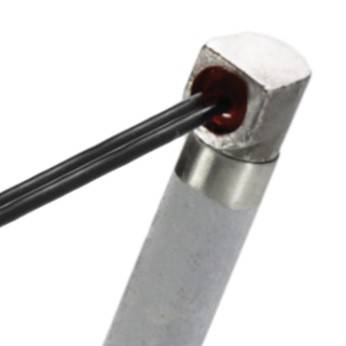 |
Right Angle Exit This cartridge heater features a 90-degree lead exit with flat sides for precise positioning using a wrench. The design also helps break oxidation bonds that may develop between the heater and its housing, making removal easier in certain industrial environments. |
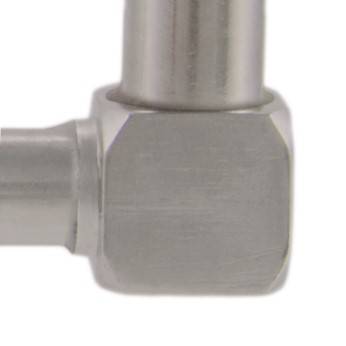 |
Right Angle Block The right-angle block features flat sides and a reinforced design for improved mechanical strength. It is suited to demanding, corrosive industrial environments, including die casting applications. This configuration also facilitates handling when the cartridge heater sheath becomes bonded to the bore. |
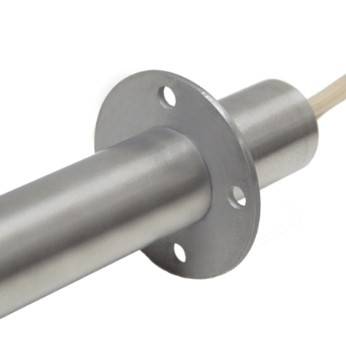 |
Flanges and NPT Fittings Mounting flanges help secure cartridge heaters in place and maintain the required insertion depth. They are particularly useful in equipment exposed to vibration. Volton offers standard flanges for various heater diameters, along with custom configurations. NPT fittings can also be added to meet specific installation requirements. |
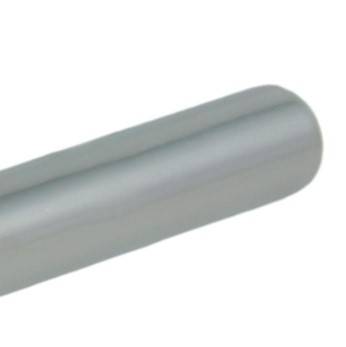 |
Centerless Grinding for Precision Tolerances Centerless grinding provides precise dimensional tolerances for industrial cartridge heaters. Volton offers a standard tolerance of 0.002 inches and a higher-precision option of ±0.0008 inches. This finishing process is particularly useful when accurate heater fitting and efficient heat transfer are critical to the application. |
Installation & Maintenance Tips
Proper installation of industrial cartridge heaters helps ensure efficient heat transfer and extends heater service life. The following recommendations cover hole preparation, heater installation, maintenance, and temperature control.
Hole Preparation and Heated Component
- Drilling and reaming: Drill and ream holes to the appropriate depth, using the recommended nominal diameter or larger.
- Hole tolerance: Maintain a maximum diameter tolerance of +0.004" / -0.000" (+0.10 mm / -0.00 mm). The preferred tolerance is +0.001" / -0.000" (+0.03 mm / -0.00 mm).
- Surface finish: Finish-ream drilled or cast holes to achieve smooth, uniform metal-to-metal contact.
- Worn or deformed holes: When possible, drill and ream the hole to accommodate a larger cartridge heater diameter.
- Heater removal: If the hole does not extend through the component, consider adding a knockout hole to facilitate cartridge removal.
- Cleaning: Remove oil, dust, debris, and other residues before installation. Use a degreaser when necessary.
- Securing the heater: Avoid using set screws to hold cartridge heaters in place. They may push the heater off-center and cause overheating.
- Heater positioning: Install the cartridge flush with the hole or allow it to extend no more than 1/16" (1.6 mm), unless an adequate extended unheated section is provided.
- Hole location: Maintain sufficient wall thickness between the heater and the working surface to reduce overheating risks. Use materials with good thermal conductivity, such as aluminum or brass.
- Lead wire support: Support lead wires to minimize mechanical stress and movement, especially in moving equipment. A wire loop can reduce stress near the cartridge exit.
- Moving or vibrating equipment: When possible, install a terminal block on the moving component and support the wires to limit movement and potential damage.
- Heat and abrasion protection: Keep heater leads away from excessive heat and abrasive surfaces.
- Thermal insulation: Add suitable insulation where possible to reduce heat loss and lower power requirements.
Cartridge Heater Selection, Installation and Maintenance
- Diameter compatibility: The minimum hole diameter must be larger than the maximum cartridge heater diameter.
- Dimensional tolerances: A cartridge heater's outside diameter is generally slightly smaller than its nominal diameter. For swaged-to-size heaters, the indicated tolerances are -0.002" to -0.006" (-0.05 to -0.15 mm), subject to technical confirmation.
- Centerless grinding: Optional centerless grinding provides tighter dimensional tolerances. The indicated values are -0.0012" to -0.0028" (-0.03 to -0.07 mm), depending on the heater configuration.
- Heater-to-hole fit: Clearance is calculated by subtracting the minimum cartridge diameter from the maximum hole diameter. Typical clearance ranges from 0.001" (0.02 mm) to 0.100" (2.54 mm), with 0.010" (0.25 mm) being a common value.
- Operating temperature: Cartridge heaters can operate at temperatures up to 1,400°F (760°C). Higher operating temperatures may limit acceptable watt density.
- Watt density: Recommended maximum watt density, expressed in watts per square inch, depends on operating temperature, heater-to-hole clearance, bore surface finish, and the material being heated.
- Power testing: For new applications, perform tests under actual operating conditions using a high-wattage cartridge heater and an appropriate power controller. These tests help determine the required power and select suitable voltage and wattage ratings. Excessively powered heaters may have a shorter service life.
- Unheated sections: Standard cartridge heaters typically have an unheated length of approximately 0.25" (6.35 mm) at each end.
- Lead exit sealing: Choose a suitable sealing material, such as ceramic, silicone, or epoxy. Consider potential exposure to plastic, oil, or moisture. Select appropriate lead wire insulation and sleeving, including fiberglass, PTFE, or silicone.
- Heater preparation: Ensure the cartridge heater sheath is smooth and clean before installation.
- Heater removal: If removal is difficult, consider a cartridge heater with a non-stick coating. Thermal or anti-seize compounds are not always appropriate and may worsen certain overheating or seizure problems.
- Storage: Store cartridge heaters in a warm, dry environment, ideally in sealed bags containing desiccant.
Temperature and Power Control
- Temperature measurement: Position the temperature sensor between the cartridge heater and the working surface.
- Power regulation: Consider SCR power controllers instead of on/off controls to reduce temperature peaks and extend heater service life.
- Soft start: During startup, operate the cartridge heater at reduced voltage or power for a short period, following the manufacturer's recommendations. This can help dissipate absorbed moisture, particularly after extended storage.
Accessories
Custom Cartridge Heater Options
Volton offers several customization options for industrial cartridge heaters to meet specific operating requirements. These configurations help improve heat distribution, moisture resistance and heater removal during maintenance.
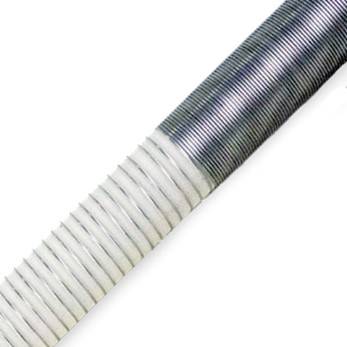 |
Distributed Wattage Cartridge heater ends are generally cooler than the central heating section. Volton offers custom resistance wire winding profiles to improve heat distribution and achieve more uniform heating. This option is particularly useful for industrial packaging, rubber processing and injection molding. Application-specific winding profiles can also accommodate challenging heater placement. |
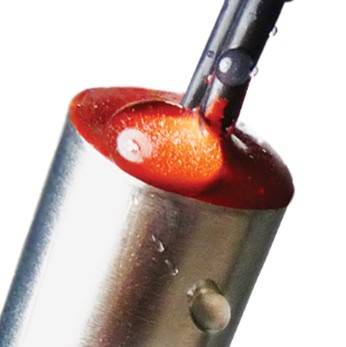 |
Moisture Resistance Industrial cartridge heaters may be exposed to moisture, frequent equipment washdowns or machining oils. Volton offers custom manufacturing and sealing options designed for these conditions. The appropriate protection depends on the operating temperature and the level of exposure to moisture or contaminants. |
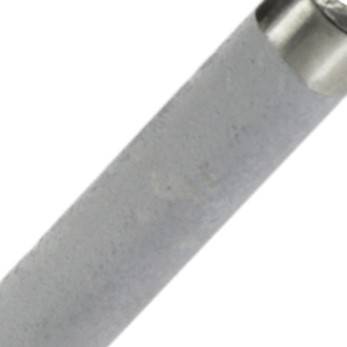 |
Anti-Seize Coating Over time, cartridge heaters may become difficult to remove from their mounting bores, particularly when oxidation occurs. Volton offers an anti-seize coating designed to facilitate heater extraction during replacement. This option can help reduce maintenance time and the associated labor costs. |
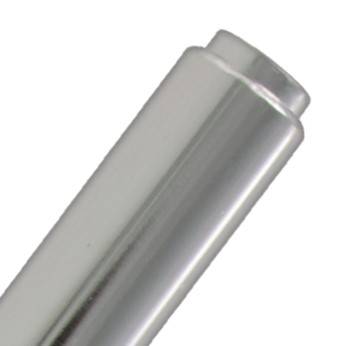 |
Knock-Out Tab The knock-out tab is a removal feature designed for cartridge heaters installed in through-bores. The tab extends beyond the opposite end of the mounting hole, allowing the heater to be pushed out during replacement. This option is particularly useful in applications prone to oxidation, where cartridge heater removal may be difficult. |
Leads & Sleeves
Volton offers a range of cartridge heater lead wires, protective sleeves and sealing materials for industrial heating applications. Selecting the appropriate components depends on operating temperature, moisture exposure, mechanical requirements and environmental contaminants.
Cartridge Heater Lead Wires
Cartridge heater lead wires provide electrical connections to the heating element. The appropriate insulation depends on the maximum temperature rating and operating environment.
 This symbol identifies moisture-resistant options.
 |
Fiberglass (Standard) Standard fiberglass insulation for cartridge heater lead wires. Maximum temperature rating: |
 |
Silicone Silicone insulation for applications requiring moisture resistance. Maximum temperature rating: |
 |
Silicone Cable Silicone insulated cable offering moisture resistance. Maximum temperature rating: |
 |
High-Temperature Fiberglass Fiberglass insulation for applications requiring resistance to elevated temperatures. Maximum temperature rating: |
 |
Teflon (PTFE) Teflon insulation for applications requiring moisture resistance. Maximum temperature rating: |
 |
Teflon (High Amperage) Teflon insulated lead wire option for high-amperage applications. Maximum temperature rating: |
Protective Sleeves for Cartridge Heater Leads
Cartridge heater protective sleeves help protect electrical lead wires from industrial operating conditions. Depending on the material, they provide mechanical protection, moisture resistance or additional protection against contaminants.
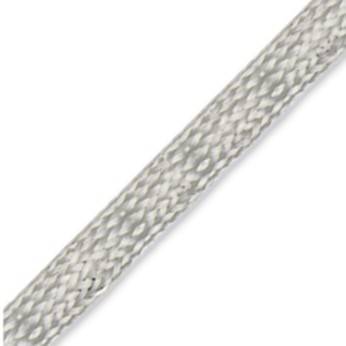 |
Stainless Steel Braid (SSB) This flexible braided metal sleeve provides durable mechanical protection for cartridge heater leads. It is commonly used in industrial applications. |
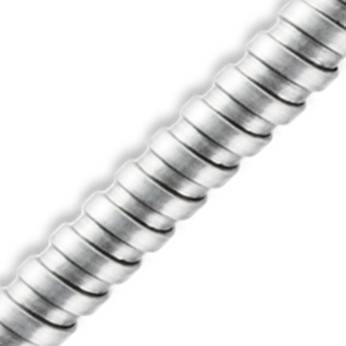 |
Armored Cable (BX) This flexible armored cable provides rugged mechanical protection for cartridge heater lead wires. |
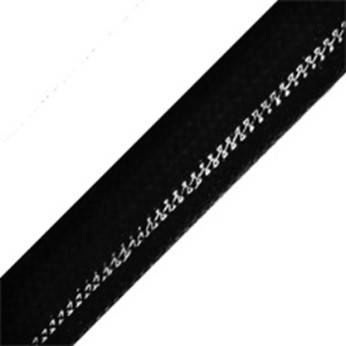 |
Silicone-Coated Fiberglass This flexible fiberglass sleeve features a silicone coating. It is suitable for humid environments and offers protection against light abrasion. |
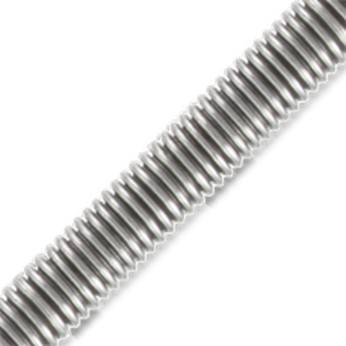 |
Gas-Proof Armored Cable This rigid, sealed armored cable provides enhanced protection against gases and liquids. It is designed for applications requiring additional lead wire protection. |
Cartridge Heater Potting and Sealing Materials
Cartridge heater potting materials protect the lead exit according to operating conditions. Selecting the appropriate sealing material depends on two main factors:
- Heater temperature: The heater itself may reach a higher temperature than the operating process.
- Operating environment: Potential exposure to moisture, oil, liquids or other contaminants.
This symbol identifies moisture-resistant sealing materials.
 |
Ceramic (Standard) Ceramic sealing material suitable for high-temperature applications. Maximum temperature rating: |
 |
Epoxy Epoxy potting material providing moisture protection. Maximum temperature rating: |
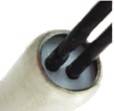 |
Teflon Teflon sealing option for applications compatible with its temperature rating. Maximum temperature rating: |
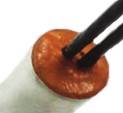 |
High-Temperature Silicone (HT) High-temperature silicone potting material offering moisture resistance. Maximum temperature rating: |
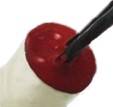 |
Silicone Silicone sealing material for applications requiring moisture protection. Maximum temperature rating: |


