 Skip site navigation


- Features
- Color chart
- Termination types
- Models
- Sensors
- Leads & Sleeves
- Documents
Features
Volton manufactures custom thermocouples and RTD sensors for accurate temperature measurement and monitoring in industrial, commercial and specialized environments. These temperature sensors help ensure reliable monitoring of equipment and manufacturing processes.
Industrial thermocouples are robust, responsive and suitable for a wide range of operating temperatures. RTD sensors (Resistance Temperature Detectors) are known for their measurement accuracy and long-term stability.
Our thermocouples are available in Types K, J, T and E. They can be customized with different protective sleeves and insulation materials, as well as several termination options.
Volton also offers Pt100 and Pt1000 RTD temperature sensors in various configurations and accuracy classes. Materials and connection options can be selected according to specific installation and operating requirements.
Types of Thermocouples and RTD Sensors
Choosing the appropriate thermocouple or RTD temperature sensor depends on the operating temperature, required measurement accuracy and environmental conditions. Below are the main characteristics of the sensors offered by Volton.
- Type K Thermocouple (Chromel-Alumel): Versatile and cost-effective, with a temperature range from -200°C to 1,260°C. Common applications include industrial furnaces, boilers and general heating processes.
- Type J Thermocouple (Iron-Constantan): Suitable for temperatures ranging from -40°C to 760°C. It is commonly used in dry or reducing environments, including certain food processing and industrial equipment applications.
- Type T Thermocouple (Copper-Constantan): Known for its stability at low temperatures, with a range from -200°C to 370°C. It is commonly used in cryogenic and refrigeration applications.
- Type E Thermocouple (Chromel-Constantan): Offers high sensitivity across a temperature range from -200°C to 870°C. It is suitable for laboratory, research and precision temperature measurement applications.
- Pt100 RTD Sensor (100 Ohms): This platinum resistance temperature sensor provides accurate and stable measurements. Volton describes configurations operating from -70°C to 500°C.
- Pt1000 RTD Sensor (1,000 Ohms): This platinum resistance sensor offers accuracy comparable to the Pt100. Its higher nominal resistance can reduce the relative influence of lead wire resistance in certain long-distance measurement installations.
Thermocouple Wire and Insulation Types
Selecting the appropriate thermocouple wire insulation depends on operating temperature, mechanical requirements and environmental conditions. Volton offers several insulation materials for industrial applications:
- PVC: Flexible and economical insulation suitable for dry, less demanding environments. Indicated temperature range: -40°C to 105°C.
- Teflon (PTFE): Offers chemical and thermal resistance for demanding industrial environments. Indicated maximum temperature: 260°C.
- Fiberglass: High-temperature insulation suitable for applications exposed to demanding thermal conditions. Indicated maximum temperature: 482°C.
- Kapton: Thin, durable insulation suitable for limited installation space and certain vacuum applications. Indicated maximum temperature: 315°C.
Color chart
Thermocouple wire color codes help identify sensor types and conductor polarity. Color conventions vary by country and standard, including French, German, British, Japanese, American and IEC references.
Use the chart below to compare color codes for Type J, K, T, E, R and S thermocouples. It shows conductor colors and positive (+) and negative (-) polarity for each reference.
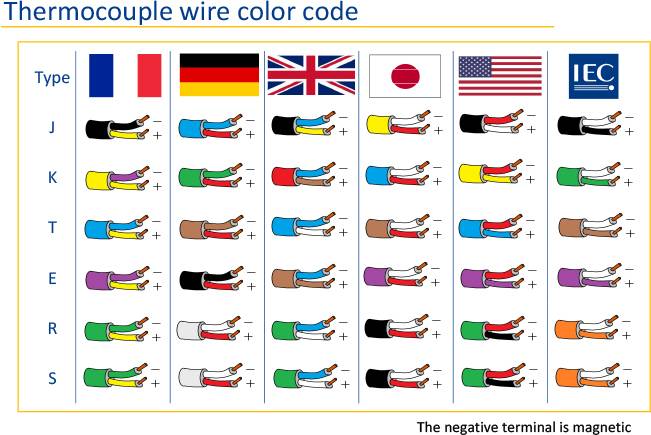
Note: The chart indicates that the negative terminal is magnetic. Always verify the thermocouple type and applicable standard before wiring or installation.
Termination types
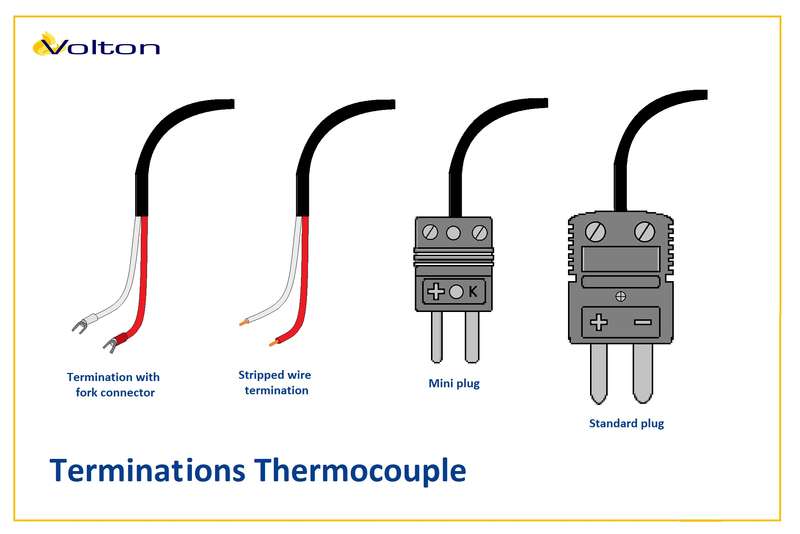
Volton offers several termination options for industrial thermocouples to meet different temperature measurement connection requirements. The appropriate termination depends on the equipment, connection type and installation conditions.
- Fork Connector Termination: Uses fork-shaped terminals to connect thermocouple leads to compatible screw terminals.
- Stripped Wire Termination: Features exposed conductor ends for direct connection to a compatible terminal block.
- Miniature Plug: A compact thermocouple connector designed for convenient connection and disconnection from compatible measurement equipment.
- Standard Plug: A standard-size thermocouple connector used to connect sensors to compatible temperature measurement instruments and control systems.
Models
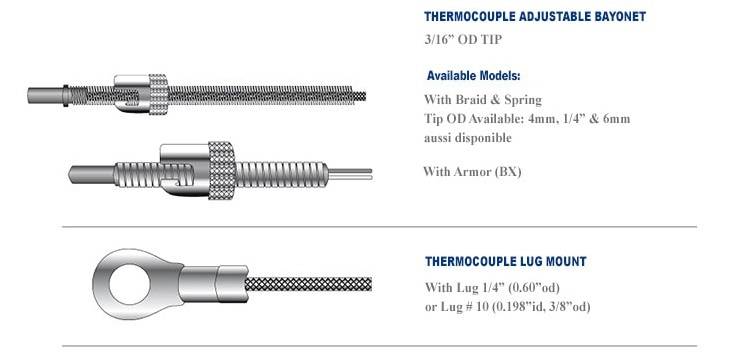
Volton offers a range of industrial thermocouple and RTD sensor models designed for different temperature measurement applications. Available configurations include adjustable bayonet mounts, threaded fittings, exposed junctions and compression fittings. Sensor selection depends on mounting requirements, measurement conditions and equipment compatibility.
Adjustable Bayonet, Lug Mount and Pad Type Thermocouples
- Adjustable Bayonet Thermocouple: Features a 3/16-inch outside-diameter tip. Available with stainless steel braid and spring or BX armor. Additional tip diameters include 4 mm, 1/4 inch and 6 mm.
- Lug Mount Thermocouple: Available with a 1/4-inch lug (0.60-inch outside diameter) or a No. 10 lug (0.198-inch inside diameter and 3/8-inch outside diameter).
Pad Type, Threaded and Exposed Junction Thermocouples
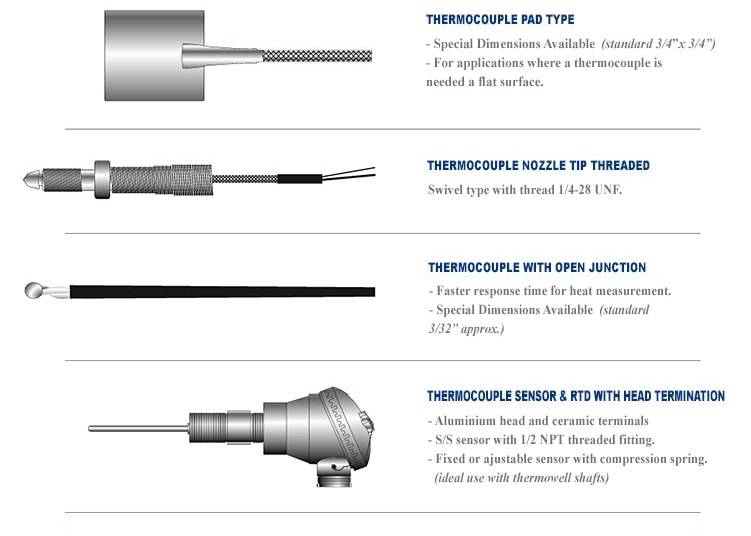
- Pad Type Thermocouple: Designed for applications requiring temperature measurement on a flat surface. Custom dimensions are available, with a standard pad size of 3/4 by 3/4 inch.
- Threaded Nozzle Tip Thermocouple: Features a swivel-type mounting mechanism with a 1/4-28 UNF thread.
- Exposed Junction Thermocouple: Designed for faster response to temperature changes. Custom junction dimensions are available, with a standard size of approximately 3/32 inch.
- Thermocouple and RTD Sensor with Connection Head: Features an aluminum connection head, ceramic terminals and a stainless steel probe with a 1/2 NPT threaded fitting. Fixed or adjustable configurations with compression springs are available, including options for thermowell installations.
MgO Thermocouples, Compression Fittings and RTD Sensors
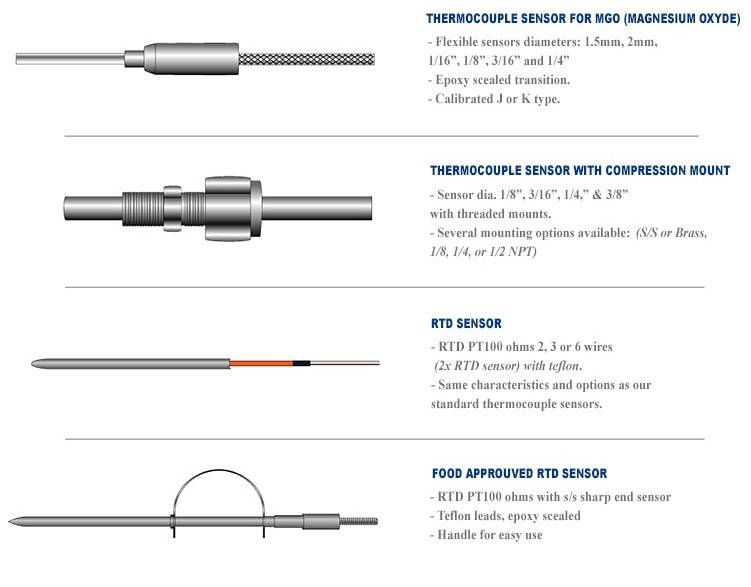
- MgO Insulated Thermocouple Sensor: Flexible mineral-insulated sensor available in diameters of 1.5 mm, 2 mm, 1/16, 1/8, 3/16 and 1/4 inch. Features an epoxy-sealed transition and is available in Type J or K calibrations.
- Thermocouple Sensor with Compression Fitting: Available in probe diameters of 1/8, 3/16, 1/4 and 3/8 inch. Threaded mounting fittings are offered in stainless steel or brass, including 1/8, 1/4 and 1/2 NPT options.
- Pt100 RTD Sensor: A 100-ohm platinum resistance temperature sensor available in 2-, 3- or 6-wire configurations, as illustrated. It can be supplied with several of the same design options as standard thermocouple sensors.
- Food-Approved RTD Sensor: Features a Pt100 element with a pointed stainless steel probe, Teflon leads and epoxy sealing. A handle is included for convenient handling during temperature measurement.
Sensors
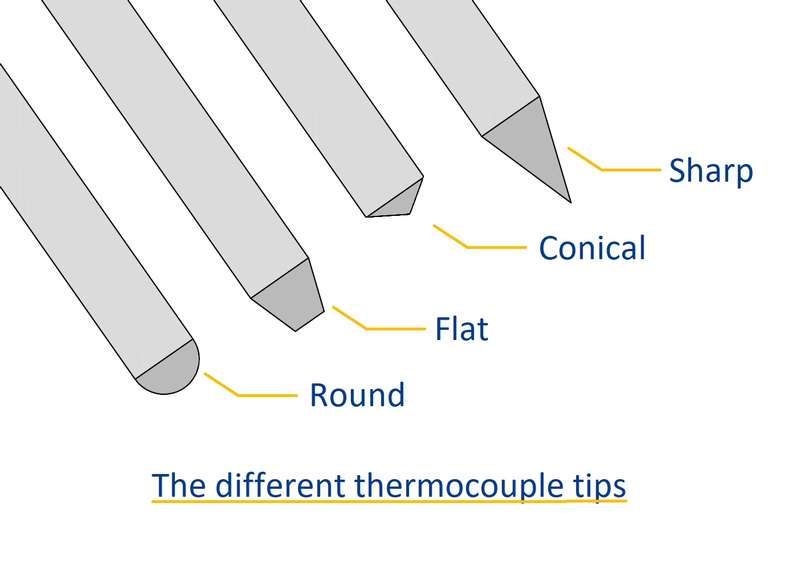
Thermocouple probes are available with different tip shapes to accommodate temperature measurement and installation requirements. Volton illustrates four configurations: round, flat, conical and sharp.
- Round Tip: A rounded probe end suitable for configurations requiring a tip without sharp edges.
- Flat Tip: A flat-ended probe configuration that may suit applications requiring contact with a surface.
- Conical Tip: A tapered probe end offering a different contact geometry depending on the installation.
- Sharp Tip: A pointed probe end designed for applications requiring a narrower tip geometry.
Leads & Sleeves
Protective Sleeves for Thermocouples and RTD Sensors
Thermocouple and RTD sensor protective sleeves help protect lead wires from mechanical stress and demanding industrial conditions. Volton offers different sleeve materials to accommodate flexibility, moisture resistance and abrasion protection requirements.
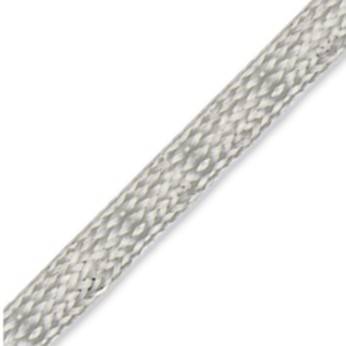 |
Stainless Steel Braid (SSB) This flexible braided metal sleeve provides durable mechanical protection for industrial thermocouple leads. It is commonly used in industrial applications. |
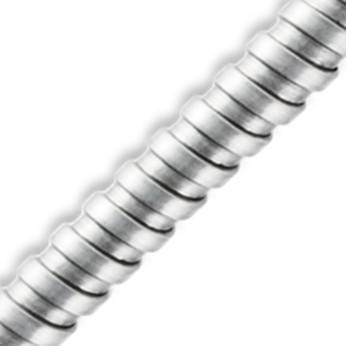 |
Armored Cable (BX) This flexible armored cable provides rugged mechanical protection for thermocouple and temperature sensor lead wires. |
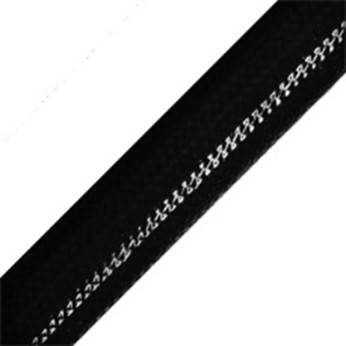 |
Silicone-Coated Fiberglass This flexible sleeve is suitable for humid environments. Its silicone coating also helps protect lead wires against light abrasion. |
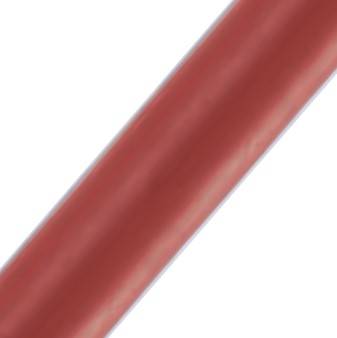 |
Silicone This sleeve offers excellent flexibility, even at low temperatures. It is suitable for applications with operating temperatures up to 200°C. |
Thermocouple Wire and Insulation Types
Selecting the appropriate thermocouple and RTD sensor lead wire insulation depends on operating temperature, environmental conditions and protection requirements. The following materials offer different thermal and mechanical properties.
 This symbol identifies moisture-resistant options.
|
Fiberglass (Standard) High-temperature insulation suitable for demanding industrial applications. Maximum temperature rating: |
Teflon (PTFE) Chemically and thermally resistant insulation suitable for humid industrial environments. Maximum temperature rating: |
|
PVC Flexible, economical insulation suitable for dry and less demanding industrial applications. Maximum temperature rating: |
Kapton Thin, durable insulation suitable for limited installation space and certain vacuum applications. Maximum temperature rating: |


